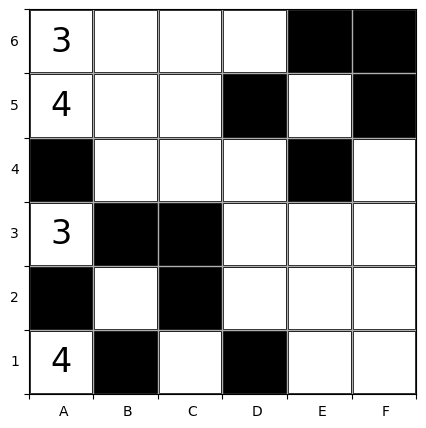
A Worked Example
Each puzzle has a unique solution that we can find by narrowing down the possibilities for each empty square, each row/column and the puzzle as a whole.
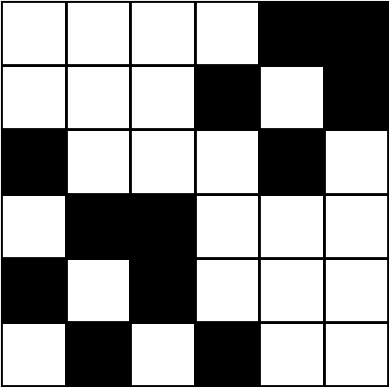
Like in Sudoku, a good place to start is with places that have fewer possibilities.
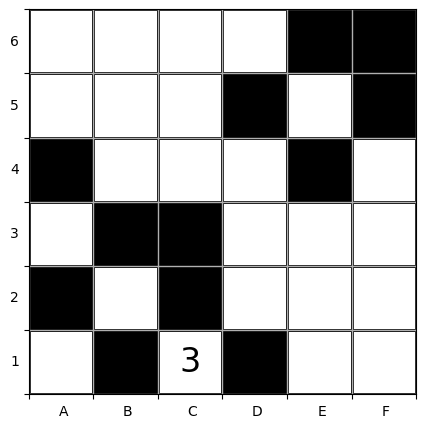
For instance, C1 only has one possible entry: 3.
1 is blocked by B1, C2, and D1.
2 is blocked by C3.
4 requires partners that exceed the puzzle's boundaries.
We can also consider the possibilities for any row or column.
In this example column A only has one possible sequence.
A5 and A6 can't both be 1, because then A1 and A3 would need to be 2 but that's blocked by C3, where a 2 would also need to be.